
on this page
It’s Monday morning in a major city region. A newly elected mayor sets out an ambitious plan for thousands of new homes, a growing employment district and a revitalised town centre, all anchored by an integrated local transport network. The vision is for strong economic growth, supported by sustainable transport.
However, as delivery begins, familiar barriers surface. Station upgrades sit in a different funding stream from local regeneration. Rail service patterns are determined nationally, disconnected from local connections. Ticketing remains fragmented, making journeys less efficient for passengers. Meanwhile, local transport plans move at a different pace to rail investment cycles.
The outcome is incremental, disjointed progress. Rail remains part of the region’s vision for growth, but not fully embedded in the place it serves.
Many in the industry, including AtkinsRéalis, have seen versions of this scenario play out across the country in recent decades. It reflects both structural fragmentation and an inconsistent approach to partnerships between rail and local leaders.
That context is now shifting.
The English Devolution Act marks a significant step in devolving power and funding, enabling locally elected leaders to play a stronger role in driving economic growth. Alongside this, the creation of Great British Railways (GBR) represents the most substantial transformation of the railway in a generation, bringing track and train together and tackling longstanding fragmentation. A new statutory role for mayoral authorities in the governance of the railway signals a major shift in how decisions will be made
Together, these changes create an opportunity to better align rail with the ambitions of places
Connecting rail to place-based outcomes
For Mayoral Strategic Authorities (MSAs), transport sits at the heart of the remit, both as infrastructure and a driver for economic growth. Rail plays a critical role in this, particularly in city regions, where it can shape travel patterns at scale. The railway is also a major land-owner in England’s metropolitan areas.
Without integration, rail risks remaining an island within metropolitan areas, rather than becoming an integral part of the urban transport network. This model supported strong passenger growth during the privatisation era, but it is unlikely to deliver the scale of modal shift now required, particularly as cities seek to respond to climate challenges and changing travel behaviours. If rail is to secure continued investment from devolved and local authorities, it must increasingly demonstrate its value as an effective partner, not just a provider.
Joint governance in practice
Encouragingly, this shift is already underway.
As detailed in a recent practitioners’ guide from the Urban Transport Group about effective rail partnerships, MSAs and rail partners across England are building the governance, capability and culture needed for effective collaboration ahead of GBR establishment.
Partnership forums and joint governance are becoming more mature, creating a single local interface with the railway and reducing duplication across organisations. This allows partnerships to be established ahead of project delivery, with a focus on collaboration from the outset.
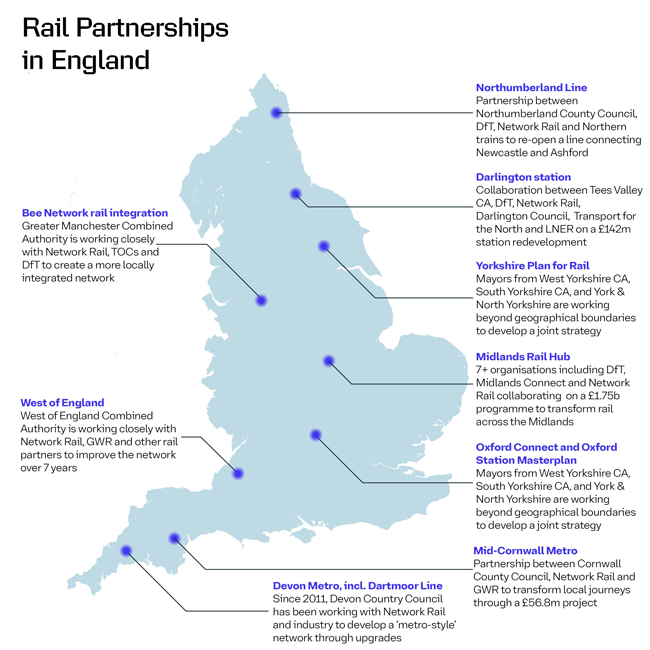
Regions such as Greater Manchester and the West of England have already introduced rail partnership boards, often chaired by the Mayor, with more following suit in other parts of the country.
Alongside this, MSAs are working with rail to develop Memorandums of Understanding (MOUs). These agreements will help to create clarity and accountability, defining shared objectives, roles and ways of working. Although places can draw on a broad framework, each arrangement is distinct and developed locally, shaped by what a place requires of the railway to achieve its ambitions.
This local ownership is imperative: partnerships will not succeed if they are imposed from the centre. Locally empowered railway leaders must be integral to shaping these agreements alongside devolved administrations.
Much of this need not be over-complicated. Perceived complexity around partnerships is one of the biggest barriers, yet progress depends less on elaborate design than on bringing the right people together and moving to delivery. Partnerships can be slowed by over-engineered governance and legal structures than by the absence of them, and pragmatic approaches unlock momentum more effectively than attempts to design perfect structures from the outset. Robust structures and managed risk remain essential, but the greater risk is delay.
Combining complementary capabilities
Successful partnerships are not defined by structure alone; they combine the distinct strengths each organisation brings.
Mayoral authorities understand local economic priorities, spatial planning, multi-modal transport integration, and how transport investment translates into homes, jobs and wider regeneration. Rail partners contribute operational expertise, national network integration and the regulatory and safety frameworks that underpin the system.
This combination matters most when navigating difficult trade-offs. Decisions about service patterns, station investment or network capacity are rarely neutral, balancing competing priorities across geography, passenger groups and funding. Strong partnerships provide the space to manage these tensions openly, with a shared focus on place-based benefits.
Underpinning both sides is a deep understanding of local passengers — their needs and travel patterns — and the broader local context. Ensuring this insight remains at the heart of decision-making will be critical to GBR’s long-term success.
Culture and behaviours that deliver
Alongside governance and capability, culture plays a central role in how partnerships function day to day.
Effective partnerships are built on mutual respect, transparency and trust. In practice, this means working together to consistently align priorities and ensure outcomes deliver value for local communities.
Examples of this approach have already emerged. The redevelopment of Darlington Station, which opened in May, marks a significant milestone in the partnership between Tees Valley Combined Authority and rail stakeholders. The scheme illustrates how aligning local growth ambitions with rail investment can improve connectivity across the region.
Similarly, on the Midlands Rail Hub, more than seven organisations including Midlands Connect, the Department for Transport and Network Rail have worked to establish a collaborative operating model.
In each case, success has been determined by a willingness to work differently — sharing information, aligning priorities early and maintaining collaboration throughout the project lifecycle.
Acting now, together
The establishment of GBR will transform how the railway is governed and structured for years to come. Its impact, however, will be shaped by the quality of partnerships between national bodies and local leaders.
Those partnerships need to be built and strengthened now. Early action allows ways of working to evolve alongside new structures, ensuring local priorities are reflected in national strategy.
The sector has already begun to demonstrate what is possible. Maintaining this momentum will be critical in the period ahead
AtkinsRéalis supported the Urban Transport Group and Network Rail with the development of Delivering local partnerships on England’s railways and the supplementary case studies. Read the full guide on the UTG website.
This article was originally published in Rail Director in June 2026.
Please note that you are now leaving the AtkinsRéalis website (legal name: AtkinsRéalis Group inc.) and entering a website maintained by a third party (the "External Website") and that you do so at your own risk.
AtkinsRéalis has no control over the External Website, any data or other content contained therein or any additional linked websites. The link to the External Website is provided for convenience purposes only. By clicking "Accept" you acknowledge and agree that AtkinsRéalis is not responsible, and does not accept or assume any responsibility or liability whatsoever for the data protection policy, the content, the data or the technical operation of the External Website and/or any linked websites and that AtkinsRéalis is not liable for the terms and conditions (or terms of use) of the External Website. Further, you acknowledge and agree that you assume all risks resulting from entering and/or using the External Website and/or any linked websites.
BY ENTERING THE EXTERNAL WEBSITE, YOU ALSO ACKNOWLEDGE AND AGREE THAT YOU COMPLETELY AND IRREVOCABLY WAIVE ANY AND ALL RIGHTS AND CLAIMS AGAINST ATKINSRÉALIS, AND RELEASE, DISCHARGE, INDEMNIFY AND HOLD HARMLESS ATKINSRÉALIS, ITS OFFICERS, EMPLOYEES, DIRECTORS AND AGENTS FROM ANY AND ALL LIABILITY INCLUDING BUT NOT LIMITED TO LIABILITY FOR LOSS, DAMAGES, EXPENSES AND COSTS ARISING OUT OF OR IN CONNECTION WITH ENTERING AND/OR USING THE EXTERNAL WEBSITE AND/OR ANY LINKED WEBSITES AND ANY DATA AND/OR CONTENT CONTAINED THEREIN.
Such waiver and release specifically includes, without limitation, any and all rights and claims pertaining to reliance on the data or content of the External Website, or claims pertaining to the processing of personal data, including but not limited to any rights under any applicable data protection statute. You also recognize by clicking “Accept” that the terms of this disclaimer are reasonable.
The information provided by Virtua Research cited herein is provided “as is” and “as available” without warranty of any kind. Use of any Virtua Research data is at a user’s own risk and Virtua Research disclaims any liability for use of the Virtua Research data. Although the information is obtained or compiled from reliable sources Virtua Research neither can nor does guarantee or make any representation or warranty, either express or implied, as to the accuracy, validity, sequence, timeliness, completeness or continued availability of any information or data, including third-party content, made available herein. In no event shall Virtua Research be liable for any decision made or action or inaction taken in reliance on any information or data, including third-party content. Virtua Research further explicitly disclaims, to the fullest extent permitted by applicable law, any warranty of any kind, whether express or implied, including warranties of merchantability, fitness for a particular purpose and non-infringement.
The consensus estimate provided by Virtua Research is based on estimates, forecasts and predictions made by third party financial analysts, as described above. It is not prepared based on information provided by AtkinsRéalis and can only be seen as a consensus view on AtkinsRéalis' possible future results from an outside perspective. AtkinsRéalis has not provided input on these forecasts, except by referring to past publicly disclosed information. AtkinsRéalis does not accept any responsibility for the quality or accuracy of any individual or average of forecasts or estimates. This web page contains forward-looking statements based on current assumptions and forecasts made by third parties. Various known and unknown risks, uncertainties and other factors could lead to material differences between AtkinsRéalis' actual future results, financial situation, development or performance, and the estimates given here.
Downloads
Trade releases