
on this page
-
Markets
-
Services

Jen Marcy
National Flood Risk Management Practice Director, New York City, New York, USA contact form+1 917 421 1480

Celinda Adair
National Lead for Flood Risk Solutions, Portland, Oregon, USA contact form+1 425 329 3703
The National Flood Insurance Program (NFIP) could be entering a period of profound transition. Long defined by significant federal oversight, detailed regulatory frameworks, and program delivery governed by the Federal Emergency Management Agency (FEMA), the NFIP now sits at the intersection of two powerful forces: a federal push toward deregulation and a broader shift of authority and program delivery to state and local governments.
Taken together, these trends could signal a fundamental rethinking of how flood risk is assessed, managed, and financed across the United States.
Recent developments—including leadership changes at the federal level and the conclusion of the FEMA Review Council—have accelerated the momentum for reform of various programs related to flood risk management, disaster grant funding, and mitigation programs. The council’s findings reinforce FEMA’s core strengths in funding and financial support but also highlight opportunities to give states and local governments primary responsibility for natural hazard resilience with the federal government in a supporting role.
Historically, the NFIP has operated as a federally driven program, with FEMA providing:
- Detailed regulatory standards (e.g., 44 CFR §60.3)
- Flood hazard mapping via Flood Insurance Rate Maps
- Enforcement of compliance and program participation
- Oversight of more than 22,000 participating communities
This model has delivered national consistency—but may have been limiting to state-level flexibility and local customization. Now we’re seeing a push towards a structural shift from top-down to bottom-up. What could emerge is a locally customized and implemented, state-led, federally supported paradigm being driven by two significant forces: deregulation and shifting authorities to states.
Driver #1: Deregulation and Statutory Alignment
One of the most consequential forces behind this shift is the growing emphasis on regulatory simplification and statutory alignment. For decades, federal agencies operated under legal “deference” in interpreting statutes into regulations. However, recent legal and policy developments have challenged that paradigm, prompting a reassessment of whether existing regulations truly align with congressional intent.
The implications are significant:
- Regulations not clearly grounded in statute may be subject to revision or repeal
- Agencies are being directed to review and potentially eliminate rules deemed to be overreaching
- Executive actions have also called for the acceleration of deregulation timelines
Within the NFIP, this raises important questions. A review of program components suggests that many regulatory elements—particularly those governing mapping and land use requirements—may not fully align with statutory language. If pursued, statutory realignment could:
- Simplify program requirements
- Reduce administrative burden
- Alter how flood risk data is created, updated, and delivered to end-users
- Redefine minimum floodplain management standards
This is not merely a technical exercise—it is a potential reshaping of the program’s foundation.
Driver #2: Shifting Authority to States
In parallel, federal policy trends are increasingly favoring state- and locally driven implementation. Recent signals include:
- Reduced federal prescriptiveness in resilience and preparedness programs
- Greater flexibility (and responsibility) for state-level decision-making Streamlining or elimination of certain federal planning and technical assistance support
- Emphasis on “partners who deliver” at the state and local level
By devolving authority, the federal government is effectively betting on increased innovation at the state level, more responsive and context-sensitive decision-making, and stronger alignment between land use and risk. However, it also introduces variability—and potential inequities—in outcomes across jurisdictions.
What Could the Future NFIP Look Like?
While uncertainty remains, a plausible future NFIP begins to take shape. Today’s model follows a standard where the federal government (FEMA) sets detailed standards and controls implementation, produces and maintains flood maps, monitors compliance, and offers two main incentives: insurance access and grant funding.
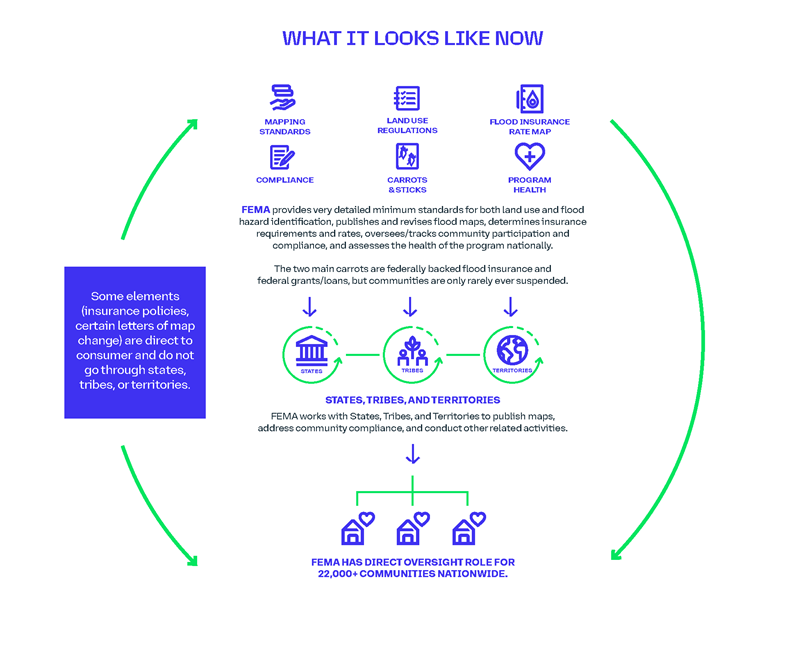
Image 1: How the NFIP currently works
One potential future of the NFIP is one where FEMA retains its core statutory authorities of identifying flood-prone areas and assessing adequacy of floodplain management standards on the state and local levels and realigns states and communities as the leaders in implementation and customization. Flood risk data becomes a central federal asset that is broadly accessible and the system relies more heavily on financial incentives from the federal level.
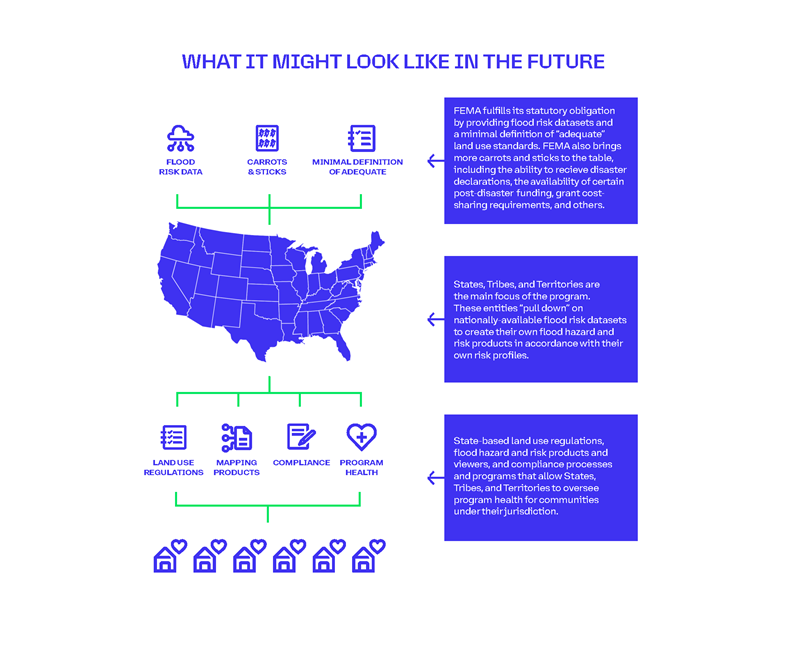
Image 2: How the NFIP could work in the future
Risks and Opportunities
This potential direction of the NFIP presents a complex blend of opportunity and uncertainty for states, communities, and flood resilience stakeholders. If this potential future becomes reality, many states may find themselves with increased flexibility, but also with significantly greater accountability if regulatory structures shift and responsibilities become more decentralized. A move toward state-led and locally customized flood risk management opens the door to more tailored, context-sensitive solutions that reflect local priorities, development pressures, and risk tolerances. At the same time, it introduces real challenges, particularly for states and jurisdictions with limited technical capacity, constrained resources, or less experience managing flood risk programs at scale.
This potential transition is not simply about doing less at the federal level—it is about doing things differently across all levels of government. States may need to stand up or expand programs that were previously federally driven, from flood hazard mapping and data management to regulatory enforcement and resilience planning. Communities, in turn, may face new expectations around land-use decisions, mitigation investments, and risk communication. Meanwhile, variability in how different states interpret and implement these responsibilities could lead to uneven outcomes, with implications for equity, insurance markets, and long-term resilience.
In this environment, the ability to navigate change proactively becomes a defining advantage.
As the NFIP continues to evolve, states, communities, and floodplain management professionals will need to closely monitor policy developments and be prepared to adapt to changing roles and responsibilities. While the ultimate direction of reform remains uncertain, the decisions made in the coming years could have significant implications for flood risk management, insurance availability, and community resilience nationwide.
Regardless of the path forward, effective collaboration among federal, state, and local partners will remain essential to ensuring that communities have the tools, resources, and information needed to understand and reduce flood risk.
This article was originally published by the Association of State Floodplain Managers in June 2026.
Please note that you are now leaving the AtkinsRéalis website (legal name: AtkinsRéalis Group inc.) and entering a website maintained by a third party (the "External Website") and that you do so at your own risk.
AtkinsRéalis has no control over the External Website, any data or other content contained therein or any additional linked websites. The link to the External Website is provided for convenience purposes only. By clicking "Accept" you acknowledge and agree that AtkinsRéalis is not responsible, and does not accept or assume any responsibility or liability whatsoever for the data protection policy, the content, the data or the technical operation of the External Website and/or any linked websites and that AtkinsRéalis is not liable for the terms and conditions (or terms of use) of the External Website. Further, you acknowledge and agree that you assume all risks resulting from entering and/or using the External Website and/or any linked websites.
BY ENTERING THE EXTERNAL WEBSITE, YOU ALSO ACKNOWLEDGE AND AGREE THAT YOU COMPLETELY AND IRREVOCABLY WAIVE ANY AND ALL RIGHTS AND CLAIMS AGAINST ATKINSRÉALIS, AND RELEASE, DISCHARGE, INDEMNIFY AND HOLD HARMLESS ATKINSRÉALIS, ITS OFFICERS, EMPLOYEES, DIRECTORS AND AGENTS FROM ANY AND ALL LIABILITY INCLUDING BUT NOT LIMITED TO LIABILITY FOR LOSS, DAMAGES, EXPENSES AND COSTS ARISING OUT OF OR IN CONNECTION WITH ENTERING AND/OR USING THE EXTERNAL WEBSITE AND/OR ANY LINKED WEBSITES AND ANY DATA AND/OR CONTENT CONTAINED THEREIN.
Such waiver and release specifically includes, without limitation, any and all rights and claims pertaining to reliance on the data or content of the External Website, or claims pertaining to the processing of personal data, including but not limited to any rights under any applicable data protection statute. You also recognize by clicking “Accept” that the terms of this disclaimer are reasonable.
The information provided by Virtua Research cited herein is provided “as is” and “as available” without warranty of any kind. Use of any Virtua Research data is at a user’s own risk and Virtua Research disclaims any liability for use of the Virtua Research data. Although the information is obtained or compiled from reliable sources Virtua Research neither can nor does guarantee or make any representation or warranty, either express or implied, as to the accuracy, validity, sequence, timeliness, completeness or continued availability of any information or data, including third-party content, made available herein. In no event shall Virtua Research be liable for any decision made or action or inaction taken in reliance on any information or data, including third-party content. Virtua Research further explicitly disclaims, to the fullest extent permitted by applicable law, any warranty of any kind, whether express or implied, including warranties of merchantability, fitness for a particular purpose and non-infringement.
The consensus estimate provided by Virtua Research is based on estimates, forecasts and predictions made by third party financial analysts, as described above. It is not prepared based on information provided by AtkinsRéalis and can only be seen as a consensus view on AtkinsRéalis' possible future results from an outside perspective. AtkinsRéalis has not provided input on these forecasts, except by referring to past publicly disclosed information. AtkinsRéalis does not accept any responsibility for the quality or accuracy of any individual or average of forecasts or estimates. This web page contains forward-looking statements based on current assumptions and forecasts made by third parties. Various known and unknown risks, uncertainties and other factors could lead to material differences between AtkinsRéalis' actual future results, financial situation, development or performance, and the estimates given here.
Downloads
Trade releases